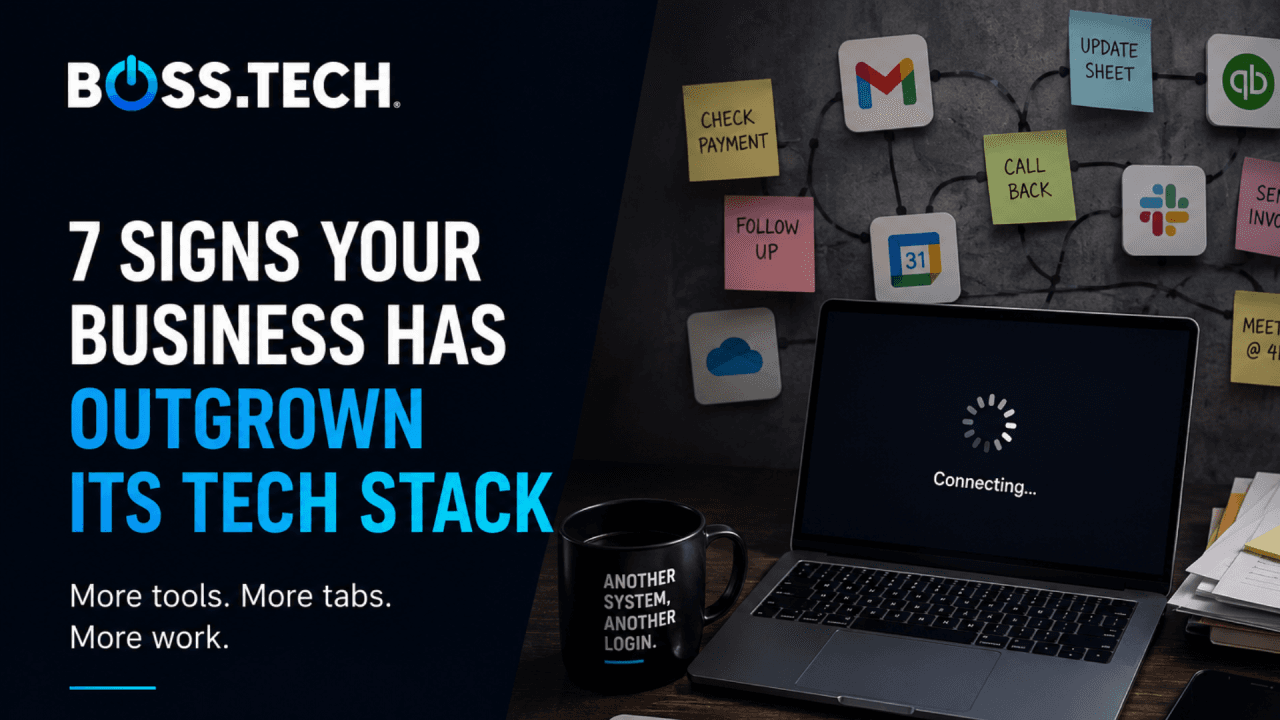
7 Signs Your Business Has Outgrown Its Tech Stack
July 31, 2026
7 Signs Your Business Has Outgrown Its Tech Stack
Most businesses don’t choose a complicated tech stack.
They build one gradually.
Accounting needs a better platform. Sales needs a CRM. The team adds messaging, scheduling, customer support, file storage, payments, reporting, and project management. Each tool solves a real problem, so every decision makes sense at the time.
Then one day, answering a basic customer question requires six tabs, three searches, and a message to the one employee who knows where everything is.
The problem may not be that your software is outdated. It may be that the business has outgrown the way those tools work together.
Here are seven signs it’s happening.
1. Simple questions require multiple systems
A customer asks whether a payment went through.
To answer, someone checks the message, opens the accounting platform, searches for the customer, confirms the payment, returns to the original channel, and writes the response.
The answer was simple. Finding it wasn’t.
When basic questions regularly become research projects, the business isn’t short on information. It’s short on connected context.
2. Customers have to repeat themselves
A customer explains an issue by email, then repeats it in a support ticket, and explains it again during a phone call.
Each employee may be doing their job correctly, but they’re seeing a different piece of the relationship.
From the customer’s perspective, they aren’t speaking to separate platforms. They’re speaking to one company. Your systems should understand the relationship the same way.
3. One employee has become the human integration
Every company has someone who knows how everything connects.
They know which spreadsheet is current, where the latest proposal lives, what the customer really meant, and why the numbers in two reports don’t match.
That person may look incredibly valuable, because they are. But when the company depends on them to translate between systems, they’ve also become a bottleneck.
Your employees should apply judgment to the work. They shouldn’t have to carry information between your tools.
4. Reporting requires a cleanup project
If every report begins with exporting files, fixing columns, removing duplicates, and comparing conflicting totals, you don’t really have reporting.
You have data assembly.
The more time your team spends preparing information, the less time it has to understand what that information means.
5. Notifications determine what gets attention
The loudest app wins.
A red badge, a new message, or an overdue task interrupts the work, even when something more important deserves attention.
Notifications can tell you that something happened. They usually can’t tell you whether it matters, how it connects to the rest of the business, or what should happen next.
When every platform creates its own version of urgency, the team spends the day reacting instead of prioritizing.
6. Your team has built an unofficial operating system
Look beyond the official software.
There may be spreadsheets, personal notes, group chats, saved email drafts, and undocumented rules holding the company together.
These workarounds usually exist because the formal systems don’t reflect how the business actually operates. They may be useful at first, but they become risky when only one person understands them.
When someone says, “Don’t touch that spreadsheet without asking Jordan,” the workaround has become infrastructure.
7. Every new tool creates more administration
A new platform is supposed to make the business easier.
Instead, the team now has another login, dashboard, notification feed, database, and place to update.
More software doesn’t automatically mean a more capable business. When the tools remain disconnected, each new platform can create another gap employees have to manage manually.
What should you do next?
Start by looking at the work, not the applications.
Ask your team which questions take too long to answer, which information they repeatedly copy, and where they go when they need the full story behind a customer, payment, task, or meeting.
Then look for the moments where context disappears.
Which information should naturally travel together? Which handoffs depend on someone remembering what happened? Which tools are working well individually but creating friction between them?
The goal doesn’t have to be replacing everything with one enormous platform. Specialized tools can continue doing what they do best.
The real opportunity is connecting them so that people no longer have to act as the integration layer.
How BOSS.Tech approaches the problem
At BOSS.Tech, we don’t believe businesses need another disconnected application competing for attention.
We’re building a Business Operating System that connects the tools companies already use and brings calls, messages, invoices, contacts, events, finances, and more into one connected experience. BOSS.Tech is designed to reduce the searching, switching, copying, and reconstructing that happens between systems.
Because the clearest sign that a business has outgrown its tech stack isn’t the number of applications it uses.
It’s how much human effort it takes to keep them working together.